S
Situation
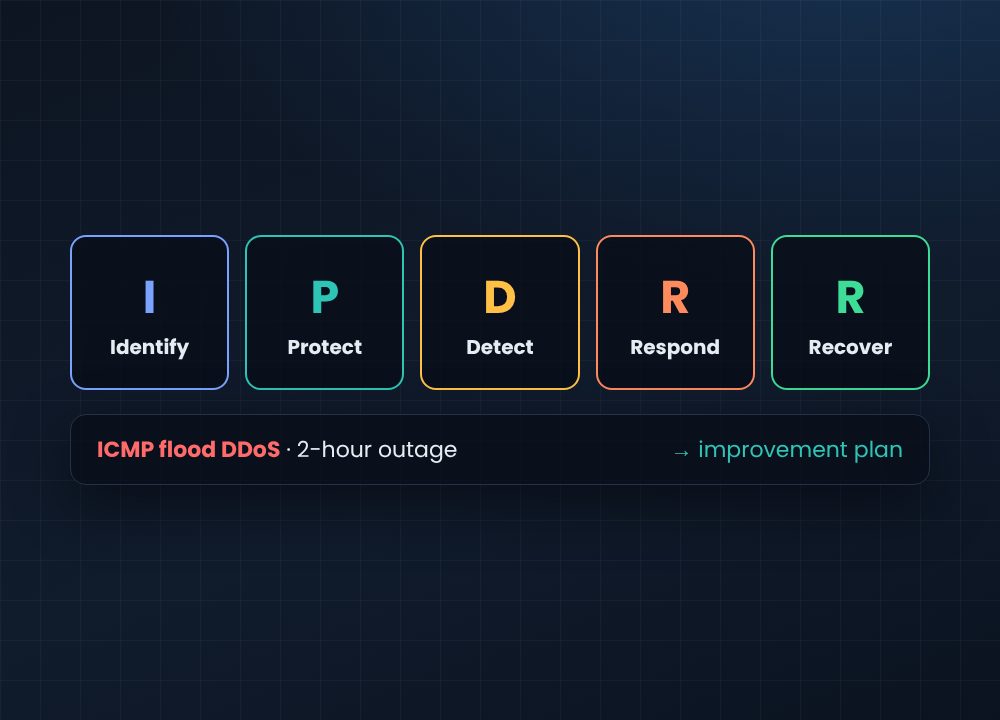
A multimedia company's internal network went down for two hours when an ICMP flood came in through a firewall that had never been configured. The team blocked ICMP, then added rate limiting, source IP verification, network monitoring and an IDS/IPS.
T
Task
Analyse the incident with the NIST CSF and create a plan to improve the company's network security.
A
Action
- Analysed the incident across Identify, Protect, Detect, Respond and Recover.
- Identified the real root cause as a process failure, with no configuration baseline or review, not just one bad device.
- Planned improvements for each function: a firewall baseline, change management and network segmentation (Protect); alert thresholds, IPS in prevention mode and a SIEM (Detect); a written DDoS playbook, communication plan and post-incident review (Respond); and tested recovery steps with upstream DDoS mitigation (Recover).
- Noted where CSF 2.0's new Govern function applies, through ownership and approval of configuration changes.
R
Result
- Produced a plan that fixes the underlying process, not just the single device.
- Showed how to use a framework to turn one incident into lasting improvements.